
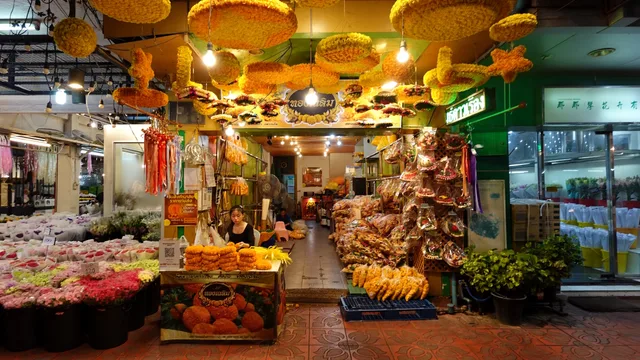
Pak Khlong Talat Flower Market
Phra Nakhon · BangkokWelcome to Pak Khlong Talat Flower Market, Bangkok's great market for flowers.
The name means 'the market at the mouth of the canal'. It describes the place well. You are standing where an old city canal meets the Chao Phraya, the river that runs through Bangkok. The market stretches along the eastern bank, at the edge of Rattanakosin Island, the historic centre of the capital, right beside the Phra Phuttha Yodfa Bridge, which locals simply call Saphan Phut.
This is not a single building. It is a trading quarter, made up of covered halls, rows of shops and commercial streets. It grew from a group of Chinese shophouses. These are narrow, deep houses, with a shop on the ground floor and living quarters upstairs. That is why the businesses line up in long rows, along the river and the streets.
In the nineteenth century, it is not flowers that are sold here, but fish. Under King Chulalongkorn, also known as Rama the Fifth, the place is nicknamed the 'fish landing'. Sea fish arrive from the coast in rowing boats. In 1893, a lady of the Siamese nobility even mentions the lingering smell of fish in a travel poem.
Under Rama the Fifth, the fish market is moved further east. The reason most often given is its smell, so close to the Grand Palace. Yet the area keeps its trading role. In the mid-twentieth century, Field Marshal Phibunsongkhram, then head of government, has other markets brought together here, to clear the surroundings of the royal monuments. Pak Khlong Talat becomes the largest market in the old city.
The flowers come next, from the late 1950s onwards. The 1960s are often described as the market's golden age. First come the orchids of Sam Phran, west of Bangkok. Then jasmine for offerings, and pandan and banana leaves. Later, flowers from the north of the country, and then from Europe.
The market is open day and night, but its rhythm changes with the hours. By day, people shop here as they would at a fresh market, for fruit and vegetables. In the evening, the flowers arrive in whole loads. It is before dawn that the market is at its busiest: florists and resellers come to stock up. Under the neon lights, the stalls overflow with cut flowers, and hands weave jasmine garlands on the spot.
These flowers serve rituals first and foremost. Jasmine is offered before statues of the Buddha. Floral arrangements accompany the baisri, ritual structures made of banana leaves, and the wai khru, the tribute pupils pay to their teachers. They also adorn weddings and funerals. A large share of the flowers you see in Bangkok, on an altar or at a ceremony, has passed through here.
The market is also a community. Some families have traded here for several generations. Their skills pass from one stall to the next: choosing the flowers, preserving them, arranging them. Among the stalls stands a small shrine dedicated to King Rama the First, founder of the Chakri dynasty. According to local tradition, the land is said to have once belonged to a royal estate.
The area is still changing today. Yodpiman River Walk, opened in 2016, houses cafés, restaurants and shops in a colonial-style building. That same year, the city cleared the vendors from the pavements. The street lost much of its night-time bustle. Since then, festivals have moved into the area, opening a debate about its transformation into a place for visitors.
Remember this: Pak Khlong Talat is neither a monument nor simply a place of trade. It is where, every night, Bangkok finds the flowers for its offerings, its celebrations and its mourning, a place of shared memory for its people.
Photo : © Eric Monteil
Source: JARUK