
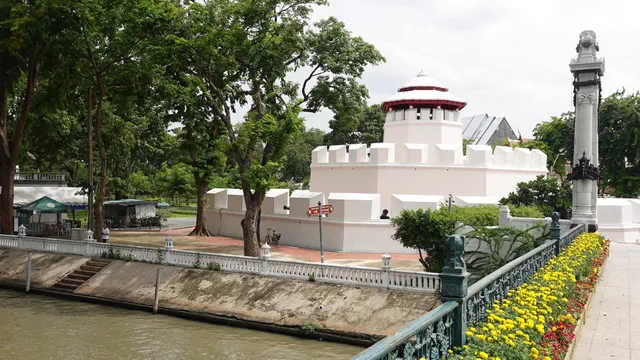
Mahakan Fort
Phra Nakhon · BangkokWelcome to Mahakan Fort, one of the last two forts of Bangkok's old city wall. Today this small white fort stands at the centre of a public park. It tells the story of the capital's birth, and also of a long conflict over the people who lived at its foot.
It all begins in 1782. General Chakri becomes king under the name Rama the First and founds the Chakri dynasty. For his new capital, the royal city of Phra Nakhon, he has moats dug and a city wall raised. The following year, in 1783, a series of forts is built along this wall. Mahakan Fort is one of them. It stands at the middle of the eastern side of the wall, on the bank of the canal that runs around the old city. Its purpose is military: to protect the capital with a continuous wall, punctuated by strongholds for artillery and for the guards.
This wall is said to have been built with materials taken from older walls, those of King Taksin's city and those of Ayutthaya, the kingdom's former capital. It would thus bear the mark of the capitals that came before it.
The city wall was about seven kilometres long and had fourteen forts. Over time, the city spread far beyond its walls, and almost everything disappeared. Only two forts remain: Mahakan and Phra Sumen.
The fort is octagonal in plan. It is whitewashed and rises over three levels to a guard post. Cannons are placed on its thick outer wall. A section of the city wall is joined to it and runs along Maha Chai Road. This wall still marks the boundary of the royal city laid out by Rama the First. It is this whole ensemble, the fort with its ramparts, that is protected. The current paintwork and lighting date from the creation of the park, in 2018.
Little by little, the fort loses its military role. In 1938, there are even plans to lease it to a private individual. Attitudes change after the Second World War. In 1949, the fort and the city wall are registered as a national ancient monument. Ten years later, in 1959, a plan for the historic Rattanakosin area provides for a small public park at the foot of the fort.
But in the narrow space between the fort and the wall lived a community, known as Pom Mahakan. The residents traced their presence back to the reign of King Rama the Third. Other accounts place it earlier or later. When they settled remains unknown. On the eve of the eviction, about three hundred people lived there. They lived mostly in wooden houses, some of which were described as a hundred years old. Traditional musical instruments and birdcages were made there. Spirit shrines sheltered at the foot of banyan trees regarded as sacred. Each house displayed a sign telling its history. The place was nicknamed a living heritage museum.
In 1992, a royal expropriation decree is issued in favour of the Bangkok Metropolitan Administration, which wants to create the park. Yet another path is explored: a living museum, where the residents would take part in restoring the houses. The Administration rejects this solution. The community, for its part, never enjoyed any protection. In 2016, an eviction order is posted and houses are demolished. On the twenty-second of April 2018, the last residents hold a farewell ceremony.
The park opens on the twenty-fourth of July 2018. A lawn crossed by paths stretches out among mature trees. The 1959 plan is thus finally carried out. But the reception is harsh. The park is judged to be little visited and lacking in historical meaning. Critics also object to the very bright white of the repainted fort and its neon-coloured lighting. How it is used is still debated today.
Remember this: Mahakan Fort is one of the last witnesses of Rama the First's royal city. It is also a reminder that this place brought together two kinds of heritage, one of stone and protected by law, the other living and without any status at all.
Photo : © Eric Monteil
Source: JARUK