
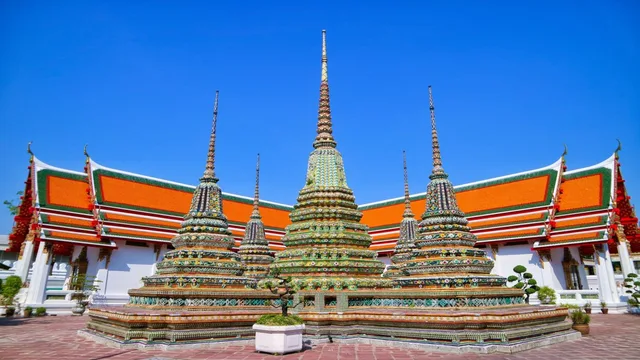
Wat Pho
Phra Nakhon · BangkokWelcome to Wat Pho, a royal Buddhist monastery in Bangkok. It stands on Rattanakosin Island, the historic heart of the city, just south of the Grand Palace. It ranks among the royal temples of the highest grade. It is often called the Temple of the Reclining Buddha. But it is also a place of royal memory and a place of learning.
Its name is the shortened form of its old name, Wat Photaram: the “temple of the Bodhi Tree”. According to Buddhist tradition, it was beneath this tree that the Buddha attained Enlightenment.
The story of this place begins before Bangkok. A first temple is founded in the Ayutthaya period, during the reign of King Phetracha. In 1767, Burmese armies destroy Ayutthaya. When the court settles in Bangkok, the temple is probably half in ruins. Rama I, the first ruler of the Chakri dynasty, makes Bangkok his capital. In 1788, he has the old temple restored, and it becomes his own temple. He has statues of the Buddha brought here from abandoned temples in Ayutthaya, Sukhothai and other ancient sites.
The bond with the king is very strong. In the ubosot, the ordination hall, the principal Buddha image rests on a pedestal. Beneath this pedestal, part of the ashes of Rama I have been laid to rest.
Yet the Wat Pho you are exploring today is mainly the work of another king. In 1832, Rama III launches a vast building programme. The work lasts more than sixteen years. Most of the present buildings date from that time. So what you are discovering is, above all, a monastery from the middle of the nineteenth century.
The most famous work belongs to this programme: the Reclining Buddha. It fills the western vihara, a hall built especially for it. It is about forty-six metres long and fifteen metres high. It is covered entirely in gilded lacquer. It is so large that the hall seems barely able to hold it. You discover it piece by piece, walking alongside it from one end to the other. Its eyes and the soles of its feet are said to be inlaid with mother-of-pearl.
Rama III has an ambition: to make Wat Pho “a university for the public”. He has ancient and contemporary texts engraved on stone tablets. These tablets are set into the walls and pillars of the temple. Above all, he opens the temple to everyone. Anyone can come here to read and to learn. That is why Wat Pho is often described as Thailand’s first university.
Today, these inscriptions number one thousand four hundred and thirty-one. They are fixed in the covered galleries, often alongside drawings or paintings. They cover history, medicine, customs, literature, proverbs and Buddhism. In 2011, they are added to UNESCO’s Memory of the World International Register. But the stones remain fragile: humidity, rain and visitors’ touch are wearing them away.
Among all this knowledge, medicine holds a special place. By the middle of the nineteenth century, Wat Pho is already a centre of medical teaching. Texts and illustrations on massage appear among its inscriptions and decorations. To this day, a school of Thai medicine is active within the temple grounds. In 2019, UNESCO inscribes nuad thai, traditional Thai massage, on the list of the Intangible Cultural Heritage of Humanity. The official announcement is made right here, at Wat Pho.
Wat Pho is still a working temple. A high white wall separates the area of worship, open to the public, from the quarters where the monks live. The upkeep of the temple is often funded by donations from the faithful.
Remember this: Wat Pho is at once a royal temple, the memory of the Chakri dynasty and, since the nineteenth century, a school open to all.
Photo : © Agoda
Source: JARUK