
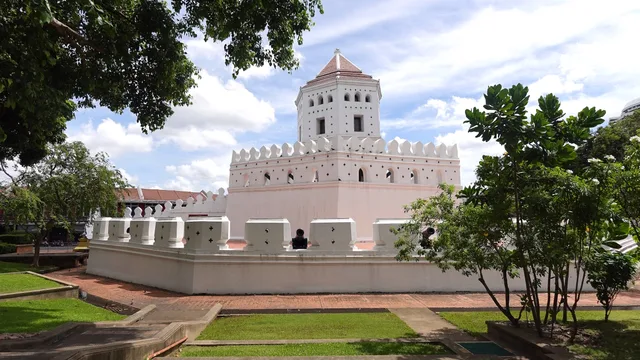
Phra Sumen Fort
Phra Nakhon · BangkokWelcome to Phra Sumen Fort, on the bank of the Chao Phraya River, at the heart of Santichaiprakan Park. This white fort is one of the last two surviving remnants of the wall that once protected Bangkok.
In 1783, King Rama the First, the first sovereign of Bangkok, has his new capital surrounded by a city wall. Fourteen brick forts line it. Phra Sumen Fort is the northern fort of this ring. It stands where Khlong Bang Lamphu meets the river. A khlong is a canal. This canal ran along the city wall. So the fort held the northern end of the city's defences.
To build quickly, Rama the First has bricks taken down at Ayutthaya, the kingdom's former capital, which by then lay in ruins. Bricks that are already fired save precious time. And an enemy can no longer dig in behind walls left standing. In this way, part of the old capital went into the foundations of the new one.
The fort is a regular octagon, on three levels. The first two are lined with parapets. That is where the defenders stood and where the cannon were placed. At the top stands a combat tower, called a ho rop. It is crowned with a domed roof, identical to that of Mahakan Fort, the other surviving fort. The walls are made of two skins of brick, filled with broken brick. It is a quick technique, suited to a building project carried out in haste.
After the reign of Rama the First, the city wall gradually loses its purpose. Under King Chulalongkorn, Rama the Fifth, who modernises the kingdom, most of the forts are demolished. Their sites give way to roads, bridges and buildings. Only Phra Sumen and Mahakan survive.
But Phra Sumen Fort did not come through this period intact. According to one hypothesis, its main body collapsed at some point between 1910 and 1928. Only its base would then have remained standing.
On 22 November 1949, the Fine Arts Department lists the fort and its walls as a national historic monument. In 1981, as the Rattanakosin bicentenary approaches, the department rebuilds the fort, based on photographs taken during the reign of Rama the Fifth. So the terraces, the tower and the roof that you see date from this reconstruction.
In 1999, excavations accompany the creation of the park, in tribute to the seventy-second birthday of King Bhumibol Adulyadej. One metre below the surface, archaeologists uncover an inverted lotus base: a moulding shaped like an upturned lotus flower. They consider it to be the base of the original fort. They also discover jars placed upside down in the foundations.
Today, the fort no longer has anything to defend. The neighbouring pavilion is used for royal ceremonies on the water, with a landing stage for the royal barges.
Remember this: beneath the silhouette rebuilt in 1981 lies the base of the 1783 fort, built with the bricks of Ayutthaya. Phra Sumen Fort tells both the story of Bangkok's birth and the way Thailand has chosen to bring its origins back to life.
Photo : © Eric Monteil
Source: JARUK