
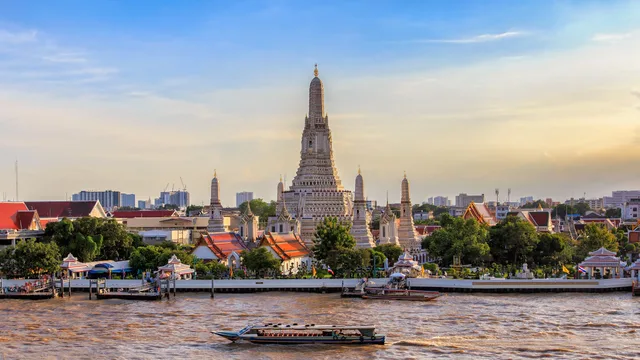
Wat Arun
Bangkok Yai · BangkokWelcome to Wat Arun, the Temple of Dawn. This Buddhist monastery stands on the west bank of the Chao Phraya in Bangkok, known as the Thonburi bank. It is one of the best-known monuments in Thailand. It is also a place of worship that is still in active use.
Wat Arun began as a small temple beside the river. It was already in use in the Ayutthaya period, when Ayutthaya was the old capital of the Siamese kingdom. At that time it was called Wat Makok, after its village. Its founding remains difficult to date.
In 1767, Burmese armies sack Ayutthaya. General Taksin retakes the city, then reunites the kingdom. He sets up his new capital at Thonburi, here, on this bank. According to tradition, he sails down the river and reaches the temple at sunrise. One fact, however, is certain: Taksin makes this temple, next to his palace, the principal temple of his kingdom. The site then takes the name Wat Chaeng. Thai people still use that name today.
From 1779 to 1784, the monastery houses the Emerald Buddha. This sacred statue was brought back from Vientiane by General Chakri. In 1784, it leaves for Wat Phra Kaew, on the opposite bank. That is where Chakri, who had become king as Rama the First, founded his capital.
The great change comes next. King Rama the Second decides to raise a new prang. A prang is a tall reliquary tower with a slender, tapering outline. The old prang stood about sixteen metres high. The new one is to encase it without destroying it. So the original shrine remains sealed inside. Rama the Second also has the ubosot built, the ordination hall, and gives the monastery the name Wat Arun Ratchataram. Work on the prang is completed under his successor, Rama the Third, in 1851. Published measurements of the tower vary, from around sixty metres to more than eighty.
Look at its shape. The central prang resembles a corn cob. This outline comes from the Khmer prasat, the tower sanctuary of the temples of Angkor. The prang represents Mount Meru, the mountain that forms the axis of the universe. Four smaller prangs surround it, like lesser peaks. The whole is an image of the world, set beside the river. It is designed to be seen from afar, from the water and from the opposite bank, facing Wat Pho.
Come closer to the decoration. The prang is built of brick and covered in stucco. Its surface is covered with fragments of Chinese porcelain and with seashells. There are also glazed tiles and Benjarong porcelain, a ceramic with decoration in several colours. The fragments form flowers and leaves. Kinnari, beings who are half woman and half bird, along with giants and deities, people this cosmic mountain. The porcelain reflects the light. It suits a temple that bears the name of the dawn.
The prang is not the whole monastery. The ubosot built under Rama the Second is known for its mural paintings. Monks are still ordained there.
Later kings look after the site. Rama the Fourth gives it its present name, Wat Arun Ratchawararam. King Chulalongkorn in turn has the prang restored. From 2013 to 2017, the Fine Arts Department carries out the largest restoration in its history. A lime plaster replaces the cement used in earlier work. When it reopens, some members of the public find the monument "whitewashed". The Department replies that it has recovered its original appearance. That same year, the site is designated an ancient monument zone. In April 2025, the Thai government approves the prang's nomination for World Heritage status.
Remember this: Wat Arun is first and foremost a monastery. Once a small riverside temple, then a royal sanctuary, today it bears a mountain of porcelain that watches over Bangkok.
Photo : © Jaruk
Source: JARUK